Home Blog Page 59

The Impact of Central Bank Digital Currency on Enhancing Financial Inclusion

0

Financial inclusion is a priority for central banks, especially in emerging and low-income countries, when considering the implementation of retail central bank digital currency (CBDC). The successful design of CBDCs can help overcome barriers to financial inclusion and encourage the financially excluded to adopt digital payment systems. CBDCs can act as a gateway to the formal financial system, offering risk-free and widely accepted digital money that can be used for offline payments. Additionally, CBDCs have the potential to reduce costs and improve accessibility. However, it is important to note that CBDCs are not a cure-all solution for financial inclusion, and further research is necessary to fully understand their impact.

Read more

The impact of central bank digital currency on advancing financial inclusion

0

Financial inclusion is a priority for central banks, especially in emerging and low-income countries, when considering the implementation of retail central bank digital currency (CBDC). The successful design of CBDCs can help overcome barriers to financial inclusion and encourage the financially excluded to adopt digital payment systems. CBDCs can act as a gateway to the formal financial system, offering risk-free and widely accepted digital money that can be used for offline payments. Additionally, CBDCs have the potential to reduce costs and improve accessibility. However, it is important to note that CBDCs are not a cure-all solution for financial inclusion, and further research is necessary to fully understand their impact.

Read more

Non-EU countries’ regulations on crypto-assets and their potential implications for the EU

0

Blockchain technology, which includes cryptocurrencies, has gained significant attention in recent years. However, understanding how it works remains a challenge for many. This overview aims to shed light on the uses and obstacles associated with this technology. Originally, blockchain emerged as a component of digital ledger technology (DLT) in the late 20th century. DLT acts as a digital database that allows for the simultaneous use and sharing of information, similar to a record book or ledger. The decentralized nature of blockchain ensures that transactions are secure and transparent, offering potential applications in various industries. Nonetheless, there are still hurdles to overcome, such as scalability and regulatory concerns.

Read more

Global Perspectives: Regulations on Crypto-Assets in Non-EU Countries and Their Potential Impact on the EU

0

In June 2023, the EU embraced a groundbreaking regulatory framework, MiCA, aiming to oversee crypto-asset markets, with a particular focus on stablecoins—crypto-assets pledging stability against official currencies. MiCA introduces stringent transparency and governance rules, alongside prudential regulations akin to traditional financial institutions. Encompassing all crypto-asset aspects, MiCA anticipates bolstering citizens’ protection, financial stability, innovation, and financial inclusion. EU Commissioner Mairead McGuinness expresses concerns about third-country financial stability. The UK commits to being a ‘crypto hub’ with comprehensive legislation, leaving detailed regulation to national financial authorities. In the US, crypto-assets, if deemed securities, fall under financial markets supervision, prompting debates on potentially stricter regulations. Academics emphasize stablecoin instability in the financial system, advocating for robust transparency and international cooperation. Despite potential adverse effects on crypto-asset market development, a tighter EU regulatory framework demonstrates limited but positive impacts, necessitating third-party policy action for enhanced financial stability.
Read more

Swift accelerate CBDC interoperability

0
Date: 18 September, 2023

Swift accelerates the development of Central Bank Digital Currencies (CBDCs) as the beta testing phase commences for an interlinking solution. Swift has progressed into a new stage of its pioneering efforts in Central Bank Digital Currency (CBDC) interoperability.
Three central banks and monetary authorities are in beta testing of Swift’s innovative CBDC connector, reflecting a rising interest in interoperability solutions. Furthermore, over 30 financial institutions worldwide are participating in the second phase of sandbox experiments to explore additional use cases. Swift has demonstrated its commitment to advancing its CBDC connector solution by initiating a beta version following an initial round of sandbox testing. Participants in the testing phase have acknowledged the solution’s “clear potential and value.”
Swift has also explored additional use cases, such as trigger-based payments for digital trade platforms, foreign exchange models, delivery vs payment systems, and liquidity-saving mechanisms. Notable participants in this expanded group of over 30 prominent institutions include the Reserve Bank of Australia, Deutsche Bundesbank, HKMA, Bank of Thailand, and CLS. It’s worth noting that the initial phase of the sandbox involved the participation of 18 central and commercial banks.
Tom Zschach, Chief Innovation Officer at Swift, remarked, “Our primary focus lies in achieving interoperability, ensuring that emerging digital currencies can harmoniously coexist with one another and with the existing fiat-based currencies and payment systems. The financial industry has already acknowledged the substantial potential of our CBDC innovations in averting digital isolation while securely connecting present and future payment systems. This subsequent phase of testing and exploration will enable us to fine-tune the solution, ensuring its maximum effectiveness, especially at scale.” 98% of global GDP, are currently exploring Central Bank Digital Currencies (CBDCs). Nevertheless, there is a concern that this widespread CBDC development, largely concentrated on domestic use cases, may lead to a fragmented landscape across international borders.
To counter this fragmentation, Swift has prioritised focus within its innovation agenda on interoperability for digital currencies and tokenised assets to enable them to seamlessly scale if and when deployed into the financial ecosystem. Its specific work on CBDCs began more than 18 months ago and, in the first phase of its experiments and sandbox testing, almost 5,000 transactions were simulated between two different blockchain networks and with existing fiat-based payment systems. Central and commercial bank participants noted that the connector enabled the seamless exchange of CBDCs, even for those built on different platforms.

References:

Swift Focuses on CBDC Interoperability as Three Central Banks Begin Beta-Testing

https://www.swift.com/news-events/news/successful-testing-paves-way-cbdc-use-cross-border

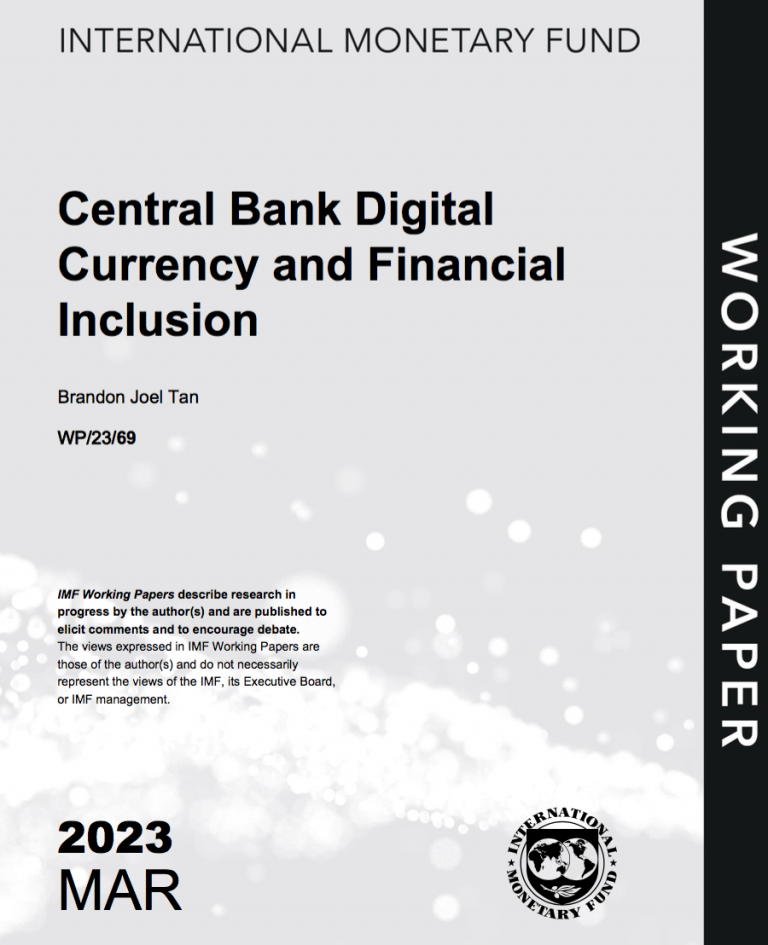
Central Bank Digital Currency & Financial Inclusion
0

According to IMF report

CBDCs in developing countries (unlike in advanced countries) have the potential to bank large unbanked populations and boost financial inclusion which can increase overall lending and reduce bank disintermediation risks.

wpiea2023069-print-pdf-1
FCA to cracks down illegal Crypto advertising

0
Date: 08 June, 2023

FCA imposes stringent regulations on the promotion of crypto assets.
Starting from October 8, 2023, the FCA has unveiled fresh advertising regulations, requiring those promoting cryptoassets to UK consumers to implement an initial investor cooling-off period.
As a part of a comprehensive set of measures aimed at enhancing understanding of the risks associated with crypto purchases, the FCA has announced the prohibition of ‘refer a friend’ bonuses. These new regulations mandate crypto companies to verify that individuals possess the requisite knowledge and experience for crypto investments. Additionally, those involved in crypto promotion must include explicit risk warnings and ensure that their advertisements are transparent, equitable, and free from any form of deception.
The FCA’s rules align with government legislation designed to subject crypto promotions to the authority’s oversight.
Sheldon Mills, the Executive Director responsible for Consumers and Competition, stated:
“While the decision to purchase crypto ultimately rests with individuals, research indicates that many individuals regret making impulsive choices. Our regulations grant people the necessary time and provide them with essential risk warnings to enable them to make well-informed decisions.
However, it is crucial for consumers to remain mindful that the crypto market remains predominantly unregulated and carries a substantial level of risk. Those who choose to invest must be ready to face the possibility of losing their entire investment.”
“The cryptocurrency sector should begin preparations promptly for this substantial shift. We are currently developing supplementary guidance to assist them in aligning with our requirements.”
These new regulations are being implemented at a time when research conducted by the FCA demonstrates a significant increase in estimated crypto ownership, which has more than doubled from 2021 to 2022. According to the survey of 2,000 individuals, 10% of respondents reported that they now possess cryptocurrency.
The approach adopted in regulating crypto promotion aligns with the FCA’s rules established last year to combat deceptive advertising of high-risk investments. Furthermore, it upholds the FCA’s three primary objectives outlined in its 2023/24 business plan: reducing and preventing substantial harm, establishing and evaluating elevated standards, and fostering competition and beneficial transformations.
Additionally, the FCA is in the process of soliciting input on supplementary guidelines that articulate the expectations for firms advertising crypto to the UK audience. Stakeholders interested in contributing to this discussion have until August 10 to provide their input.

hat if you want to have different headers on different parts of your site?

Conclusions

Having seen the 4 zones of the Header Builder, you’re now ready to tackle making the Header for each one by yourself! Start small, with simple elements and ideas then think bold and grow your design through it.

Create amazing layouts for your site and choose the one you want to show on each template in particular. The new Header Builder allows infinite possibilities to style your website.

What if you want to have different headers on different parts of your site?

In this case, you can go to a category page for example and edit the Header Template (by following the steps from above). Do not assign the header template as Global and you’re done. The chosen category page has a different header than the homepage. You can do this for any page or single post.

Conclusions

Having seen the 4 zones of the Header Builder, you’re now ready to tackle making the Header for each one by yourself! Start small, with simple elements and ideas then think bold and grow your design through it.

Create amazing layouts for your site and choose the one you want to show on each template in particular. The new Header Builder allows infinite possibilities to style your website.

References:

https://www.fnlondon.com/articles/fca-to-ban-crypto-referral-bonuses-under-new-advertising-rules-20230608

https://www.retailbankerinternational.com/news/fca-cracks-down-on-crypto-marketing/

EU Markets in Crypto-Assets Regulation (MiCA) will protect consumers and investors

0
Date: 20 April, 2023

The Council has approved fresh regulations regarding markets in crypto-assets (MiCA), encompassing crypto-assets, issuers of crypto-assets, and providers of crypto-asset services within the European Union. This marks the first instance of the EU establishing a comprehensive legal framework for this sector. The Council’s decision today finalizes adopting the MiCA regulation at the EU level.
“I am delighted that today we are fulfilling our commitment to commence regulating the crypto-assets sector. Recent developments have reaffirmed the pressing requirement for implementing regulations to enhance the protection of Europeans who have invested in these assets and deter the illicit use of the crypto industry for money laundering and terrorist financing purposes.”
Elisabeth Svantesson, Sweden’s Minister for Finance

MiCA will enhance investor protection through heightened transparency and establishing a comprehensive framework for issuers and service providers, encompassing adherence to anti-money laundering regulations. These newly enacted rules encompass issuers of utility tokens, asset-backed tokens, and commonly known ‘stablecoins,’ along with service providers such as trading platforms and cryptocurrency wallets. The overarching goal of this regulatory framework is to safeguard investors, ensure financial stability, encourage innovation, and bolster the appeal of the crypto-asset sector.
Additionally, it introduces a unified regulatory framework across the European Union, which, given the global nature of cryptocurrency markets, represents a significant improvement over the current scenario where some member states rely solely on their national legislation.
Context:
The MiCA proposal was introduced by the European Commission on September 24, 2020, as a component of the broader digital finance package. This package is designed to establish a European strategy promoting technological advancement while safeguarding financial stability and consumer interests. Alongside the MiCA proposal, this package encompasses several other key elements, including a digital finance strategy, the Digital Operational Resilience Act (DORA), which also extends to crypto-asset service providers, and a proposal for a pilot regime regarding distributed ledger technology (DLT) for wholesale applications.
This package serves as a crucial link in the existing EU legislation, addressing the need to prevent the current legal framework from impeding the adoption of innovative digital financial instruments. Simultaneously, it establishes that these new technologies and products should be subject to financial regulations and operational risk management practices applied by companies operating within the EU. Consequently, the package has a dual objective: facilitating innovation and the adoption of emerging financial technologies while ensuring an adequate degree of protection for consumers and investors.
The Council endorsed its negotiating mandate concerning MiCA on November 24, 2021. Subsequently, trilogue discussions among the co-legislators commenced on March 31, 2022, ultimately concluding with a provisional agreement reached on June 30, 2022.

References:

https://www.bbva.com/en/innovation/eu-markets-in-cryptoassets-mica-regulation-what-is-it-and-why-does-it-matter/

PHP Code Snippets Powered By : XYZScripts.com